By Diedre Johnson
Daily Commerce Staff
Tuesday August 11, 1987
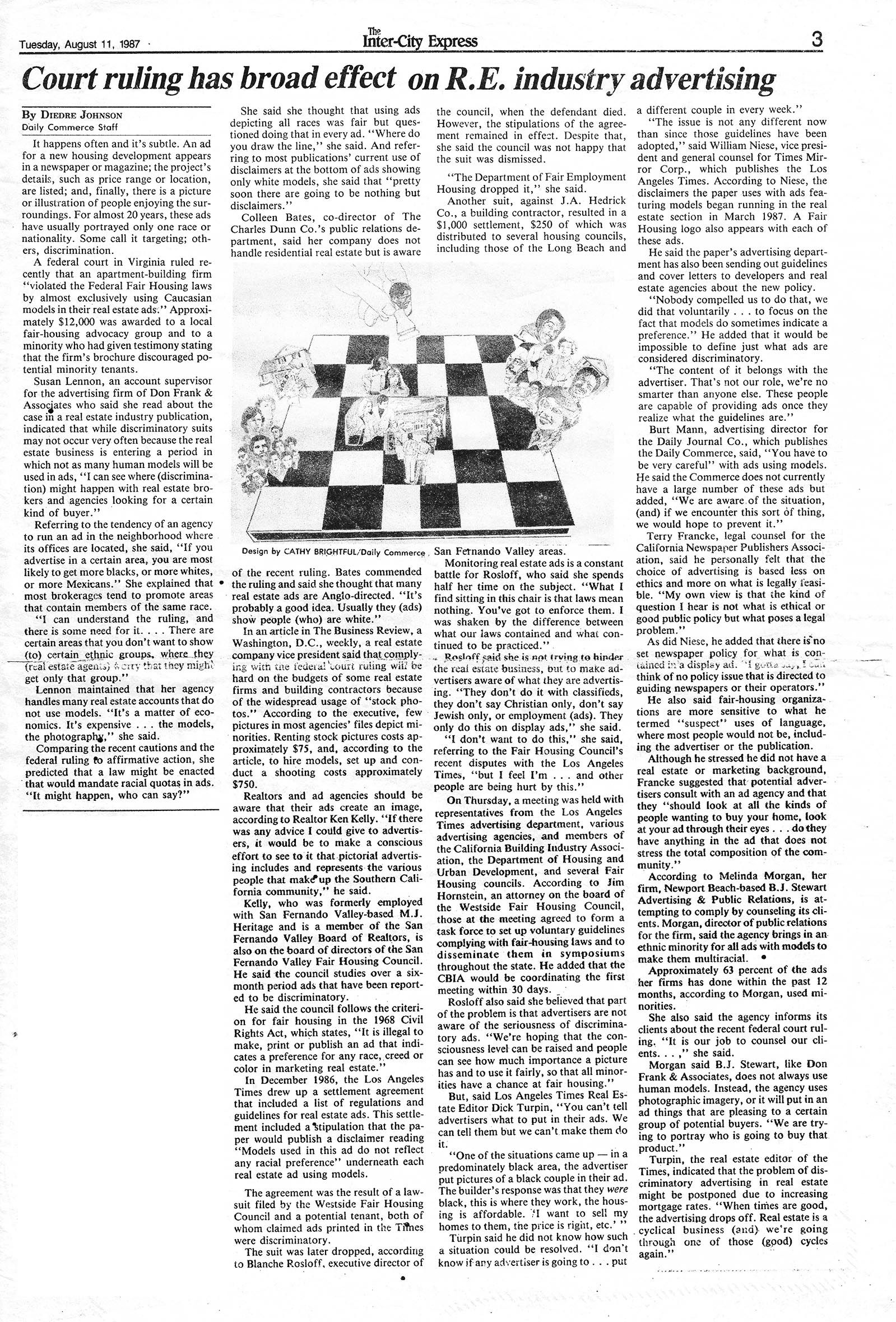
It happens often, and it’s subtle. An ad for a new housing development appears in a newspaper or magazine. The project’s details—such as price range or location—are listed, followed by a picture or illustration of people enjoying the surroundings. For almost 20 years, these ads have typically portrayed only one race or nationality. Some call it targeting; others call it discrimination.
A federal court in Virginia recently ruled that an apartment-building firm violated the Federal Fair Housing Act by almost exclusively using Caucasian models in its real estate ads. Approximately $12,000 was awarded to a local fair-housing advocacy group and to a minority individual who testified that the firm’s brochure discouraged potential minority tenants.
Susan Lennon, an account supervisor at Don Frank & Associates, said she learned about the case in a real estate industry publication. While she noted that fewer ads now feature human models—making such lawsuits less frequent—she added, “I can see where discrimination might still happen with real estate brokers and agencies looking for a certain kind of buyer.”
Lennon said she believes ads should depict people of all races but questioned whether that must apply to every ad. “Where do you draw the line?” she asked. She also pointed to the growing use of disclaimers on ads showing only white models. “Pretty soon, there are going to be nothing but disclaimers,” she said.
Colleen Bates, co-director of public relations at The Charles Dunn Co., said that although her company does not handle residential real estate, she was aware of the court’s decision. Bates commended the ruling and noted that many real estate ads appear “Anglo-directed.” “It’s probably a good idea,” she said. “Usually they show people who are white.”
The ruling has sparked wider conversations across the industry. William Niese, vice president and general counsel for Times Mirror Corp., which publishes the Los Angeles Times, said the paper began adding disclaimers and Fair Housing logos to real estate ads featuring models in March 1987. He explained that the Times also distributes guidelines and cover letters to developers and real estate agencies about its policies. “Nobody compelled us to do that—we did it voluntarily to emphasize that models can sometimes indicate a preference,” Niese said. Still, he acknowledged, “It would be impossible to clearly define which ads are discriminatory.”
Other media companies are taking a similar stance. Burt Mann, advertising director for the Daily Journal Co., which publishes the Daily Commerce, said, “You have to be very careful” with ads featuring models. He added that while the Commerce does not run a large number of such ads, “if we encounter this sort of thing, we would hope to prevent it.”
Fair-housing advocates, however, stress that voluntary policies are not always enough. Blanche Rosloff, executive director of the Westside Fair Housing Council, said that laws mean little without enforcement. “I was shaken by the difference between what our laws contained and what continued to be practiced,” she said.
The financial impact is another concern. Industry executives note that many firms rely heavily on “stock photos,” few of which depict minorities. Renting such photos costs about $75 each, while hiring models and staging a photo shoot can cost around $750.
Still, some advertising firms are working proactively to comply. Melinda Morgan, director of public relations at Newport Beach–based B.J. Stewart Advertising & Public Relations, said her agency brings in at least one ethnic minority model for all ads, making them multiracial. About 63 percent of the firm’s ads in the past year, she noted, featured minorities.
Realtor Ken Kelly, a member of the San Fernando Valley Fair Housing Council, said advertisers must recognize the broader impact of their images. “If there was any advice I could give to advertisers, it would be to make a conscious effort to ensure that pictorial advertising reflects the diversity of the Southern California community,” he said.
As the debate continues, industry leaders, fair-housing groups, and newspapers are working toward clearer voluntary guidelines. Whether those efforts will be enough—or whether stricter regulations will follow—remains to be seen.